// TEMPLATE
Get the AI Acceptable Use Policy Template for Businesses
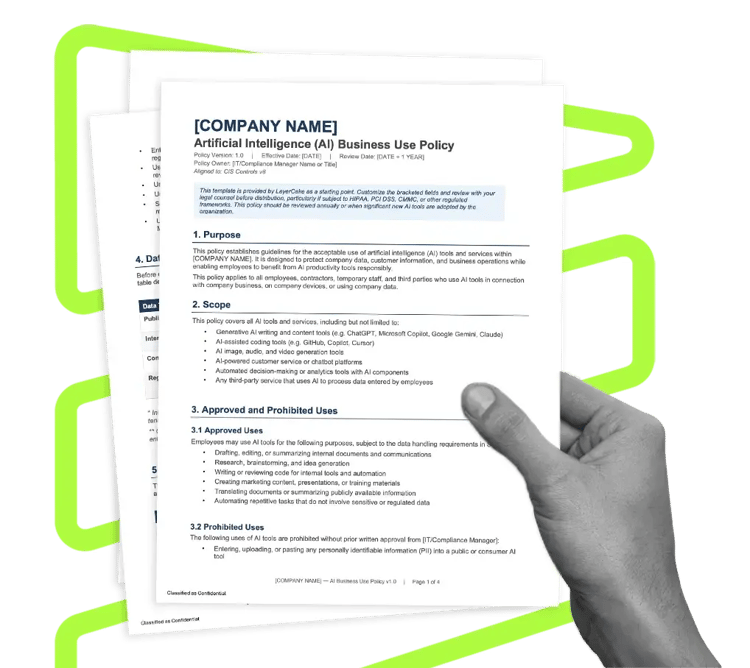
This free AI policy template gives you a ready-to-customize document that sets clear rules for your team around acceptable uses of artificial intelligence tools for business purposes.


Your employees are using AI tools. Give them guidelines.
From drafting emails to writing code, employees are likely feeding company information into ChatGPT, Copilot, Gemini, and dozens of other AI tools.
Without a clear AI governance policy, you're left hoping they make the right call when it comes to sharing proprietary and potentially confidential information.
Having a documented AI acceptable use policy helps your business:
- Lower the risk of sensitive data ending up in public AI tools
- Set guidelines for which AI tools are approved and why
- Create accountability for AI-generated work
- Stay ahead of compliance obligations tied to HIPAA, PCI DSS, CMMC, and other frameworks
What's in your AI business use policy template:
Classify Data and Set AI Handling Rules
Build an Approved AI Tools List
Set Account and Access Standards
Set Requirements for AI-generated Content
Create an Incident Reporting Process
Built for businesses that want to stay ahead of AI risk
If you're starting to notice ChatGPT tabs open across the office, it's time to create an AI policy. This template gives you a practical starting point for formalizing how AI gets used at your company.
This template is perfect for:
- IT and compliance leaders
- HR teams rolling out AI usage guidelines
- Business owners and executives
- Legan and risk management teams
- Organizations subject to regulatory frameworks

// DOWNLOAD
Give your team a clear AI governance policy
AI isn't going away, and neither is the risk of employees using it without guardrails. This template gives you a solid foundation for an artificial intelligence policy your team can follow.
What should be included in a corporate AI policy?
For an AI acceptable use policy to be effective, it should define approved and prohibited AI uses, classify data by sensitivity (public, internal, confidential, regulated), list which AI tools are approved for company use, set account and access requirements, establish standards for reviewing AI-generated content, and outline how employees should report AI-related incidents or attacks. Our template covers all of these in one customizable document.
Why is it important to have an AI business use policy?
Without a documented policy, employees are left to make their own judgment calls about what's safe to share with AI tools, and they don't always make the right decisions. An AI business use policy reduces the risk of sensitive data exposure, keeps your organization aligned with regulatory requirements, and gives employees clear guidance.
Should small businesses adopt an AI use policy, or just large businesses?
All companies should have an AI policy of some sort, and this template provides a great starting point. It is built so both a 10-person company and a 500-person company can tailor it to their own tools, data sensitivity, and risk tolerance.
How is an AI policy different from a general technology use policy?
A general technology use policy broadly covers devices, networks, and software. An AI policy goes further by addressing how data is classified for AI tool use, which AI platforms are approved, how AI-generated content should be reviewed and disclosed, and how to report AI-specific incidents like data exposure or AI-generated phishing attempts.
Is this AI policy template legally binding?
This template is designed as a starting point, not a finished legal document. We recommend reviewing and customizing it with your own legal counsel before distributing it to employees, especially if your organization is subject to HIPAA, PCI DSS, CMMC, or other frameworks.